AI Doesn't Have to Be Complicated: How I Saved $50 on Groceries in 5 Minutes
How a simple AI browser agent saved me $55 on a single grocery order—and why this is now part of my regular shopping routine.
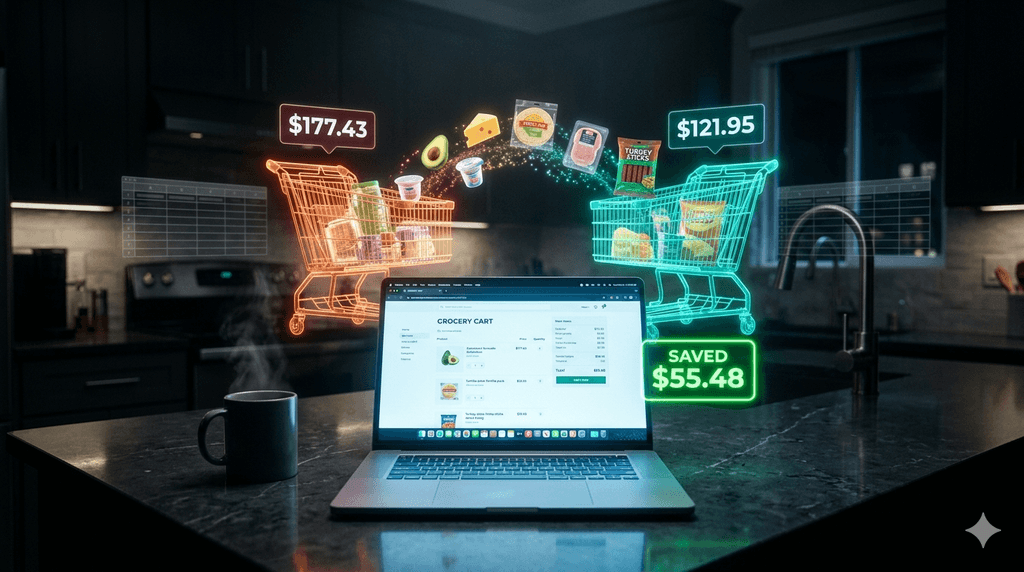
Great weekend use of AI: I had just placed my usual grocery online order and a familiar thought crept in—what if I could have saved money at another store?
Usually, that thought ends right there. Nobody wants to spend their Saturday morning manually searching for 27 items across different tabs to build a comparison cart. But instead of doing it myself, I decided to hand the job over to an AI agent.
The result? Over $50 in potential savings on a single order.
I shop like this roughly twice a month, so that's $100+ I could be saving every month. Going forward, this is my new routine: place my order, let AI build a comparison cart at a competitor, and then decide where to buy next time.
Here is exactly how I did it, and how you can do it too.
The Setup & The Prompt
You don't need to be a developer to pull this off. All you need is Google Chrome, your recent order visible on the screen, active store logins, and an AI agent capable of controlling a browser (I used Claude Cowork).
Once I had my regular supermarket order open, I gave Claude this exact prompt:
Use chrome to view my recent [Store A] online grocery order. Then go to [Store B's website] and reassemble as close to the same order as possible so I can compare prices. Do NOT place any orders, just assemble a cart with items that are as close as possible to my recent [Store A] order (which is currently visible in chrome)
If you try this, the most important part of the prompt is that third sentence. When you give an AI the keys to your browser and your logged-in accounts, you have to establish firm boundaries. Telling it explicitly not to place the order is the difference between a helpful price comparison and an unexpected credit card charge.
The phrase "as close to the same order as possible" is the secret sauce. It gives the AI permission to act like a real shopper, making judgment calls on substitutions rather than just giving up if an exact match isn't found.
How It Works: The AI In Action
Once I hit enter, I just sat back and watched the AI take over my screen. It was fascinating to see how closely it mimicked a human navigating the web.
Here is what the workflow actually looked like under the hood:
- Ingestion: It didn't just start clicking wildly. It first navigated to my original order history, expanded the view, and used page text extraction to commit all 27 items to memory before opening the competitor's tab.
- Smart Substitutions: It actively navigated the store's local inventory. When it realized my exact brand of premium deli meats wasn't carried at the big-box store, it pivoted to a comparable pre-packaged brand. When my preferred cheese was out, it grabbed another name brand. When my specific turkey sticks were out of stock, it smartly threw the beef versions into the cart instead.
- Troubleshooting the UI: This was the most impressive part. At one point, the AI was trying to add a bag of chips directly from the search results page. When it noticed the cart total wasn't updating, it stopped, realized the button wasn't registering, and clicked directly into the product page to add it from there. It recognized an error and corrected its own behavior.
- The Output: It didn't just leave me with a loaded cart. Once it finished adding the groceries, it analyzed the final totals and automatically generated a clean price-comparison spreadsheet for me to review.
The Receipts
The math spoke for itself.
<table>
<tbody>
<tr>
<td>Original Store Matched Items</td>
<td>$177.43</td>
</tr>
<tr>
<td>Comparison Store Matched Items</td>
<td>$121.95</td>
</tr>
<tr>
<td><strong>Total Savings</strong></td>
<td><strong>$55.48</strong></td>
</tr>
</tbody>
</table>
The AI accurately noted that 7 items from my original order couldn't be matched or substituted, leaving about $31 on the table.
It wasn't completely flawless, either. It accidentally added a duplicated pack of keto tortillas from a third-party seller that was priced too high, and it dropped an avocado mash along the way. But that's exactly why the human review at the end is mandatory. The AI did 99% of the tedious clicking, dragging, and searching, leaving me to just review the final cart and remove the anomalies.
The Takeaway
There is a lot of noise right now about AI taking over complex, world-changing workflows. But AI doesn't have to be complicated to be incredibly valuable.
Sometimes, the best use of an advanced neural network is just letting it do a few minutes of tedious work to save you money on chopped salad and zero-sugar yogurt while you do something else.